Link to the original article :
https://www.koreatimes.co.kr/path/A2025091316230005288
Korea’s higher education system stands at a critical crossroads. With global competition intensifying, local universities can no longer rely on domestic recognition to maintain their standing.
Jung Min-chul, partner at Samil PwC, said that the country’s growth potential depends on how the government, academia and industry work together to drive universities’ global competitiveness.
“Higher education lies at the heart of national competitiveness. Globalizing Korea’s higher education is no longer optional. It is essential for attracting global talent and sustaining the nation’s overall economic strength,” Jung said in his keynote speech during the Korea Times Global Conference on Wednesday.
He explained that traditional models of higher education are rapidly changing as new players reshape the landscape.
Online learning platforms are making the world’s top courses accessible to everyone, while major tech companies are entering education with their own training programs.
At the same time, artificial intelligence (AI)-powered translation and multinational research projects are breaking down barriers, creating a far more competitive and interconnected global landscape.
“In such an environment, Korean universities can no longer rely on domestic recognition alone,” Jung said. “They need to step up investment in global branding, expand research partnerships and bring in more international talents.”
Citing examples from top-ranked global universities such as Harvard, Stanford, Massachusetts Institute of Technology (MIT) and Nanyang Technological University, Jung outlined several key strategies driving their global influence.
Among them are focuses on building overseas campuses and centers to broaden education and research networks, draw international students and offer joint degree programs.
Another key strategy is knowledge-sharing through digital platforms, such as online open courses and digital degree programs, to spread academic influence worldwide. Harvard, Stanford and MIT have paved the way by offering free access to their high-quality education to learners across the globe, Jung noted.
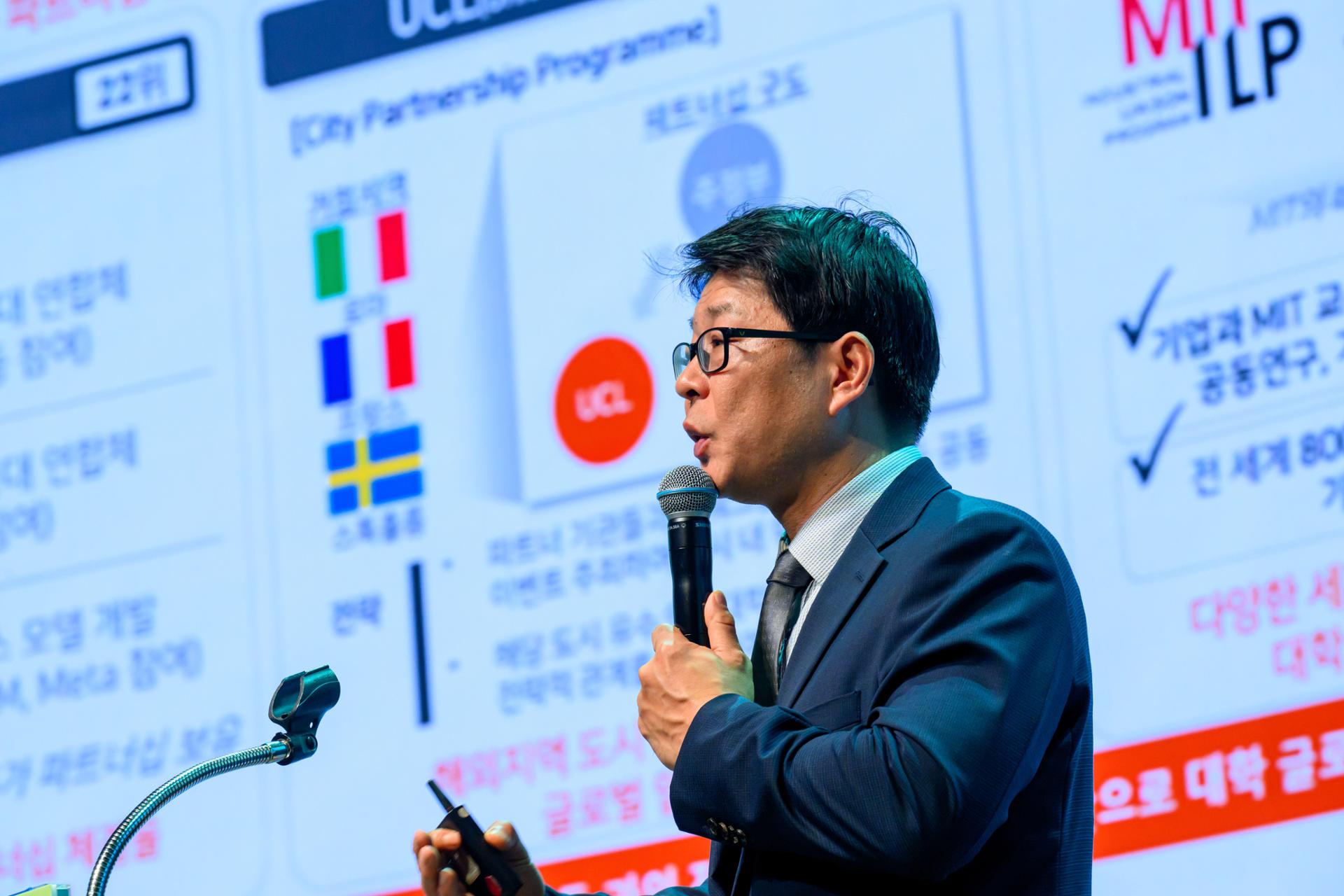
The next strategy is building global research partnerships with corporations, cities and academic institutions to strengthen international competitiveness and expand research ecosystems. MIT, for instance, works with more than 800 companies worldwide, while University College London has forged multilateral ties with leading research universities and city institutions to bolster its global research brand.
The ultimate strategy, the expert said, is to establish a strong identity and brand, noting that top-tier universities leverage their distinctive strengths to enhance global influence.
“These strategies show that global competitiveness requires both academic excellence and innovative outreach,” Jung said.
The expert called on the government and universities to work together to drive changes in the higher education sector.
Examples show that while government funding can bolster the competitiveness of higher education institutions, excessive state intervention and regulation may impede the steady growth of the sector.
Singapore, with only six national universities, has propelled two of them into the world’s top 30 by aligning policies, funding and infrastructure. This success is partly due to government investments in emerging fields such as AI, biotechnology and fintech, as well as efforts to attract leading global scholars through various fellowship programs.
Japan, on the other hand, offers a cautionary example, Jung said. Despite more than a decade of policies aimed at increasing international student enrollment, data shows that the global standing of its universities has declined.
“This is mainly due to excessive government regulations that limit university autonomy, insufficient public funding that forces universities to rely heavily on tuition, slow progress in research support and a closed education environment that often fails to fully integrate foreign students,” Jung said.
Jung warned that Korea may face similar challenges, as many local universities remain constrained by heavy government regulation and struggle due to budget issues.
The expert also pointed out Korea’s structural disadvantage in attracting foreign talent as a non-English-speaking country, emphasizing the need for universities to increase English-language programs and expand foreign faculty members.